
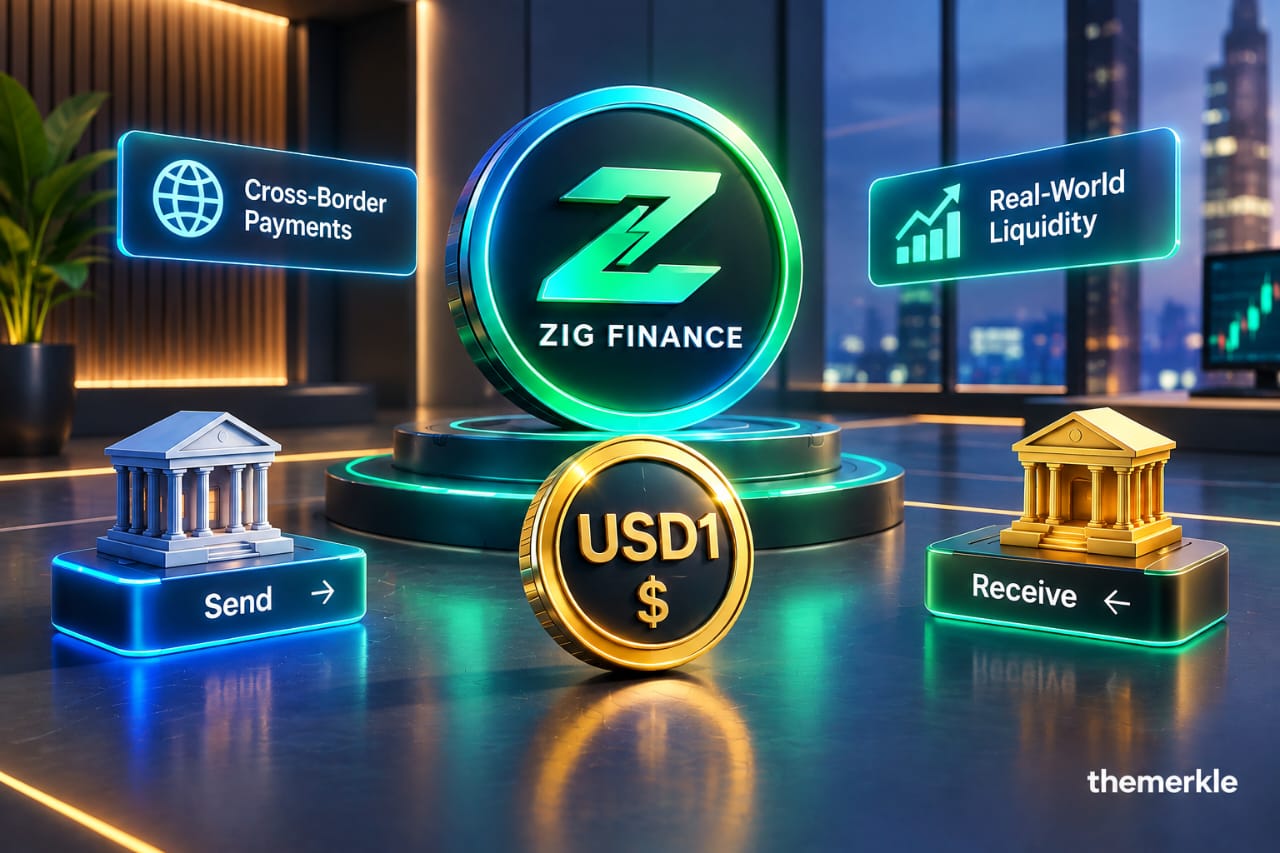
ZIG Finance and World Liberty Financial have partnered to put the USD1 stablecoin to work financing cross-border payments.
The first product is live: a PayFi Vault on Concrete that lends short-term liquidity to the money-transfer businesses that move remittances between countries.
The partnership is notable less for the stablecoin than for who is placing it. ZIG started in 2018 as Zignaly, a social platform where retail users copied experienced traders, and it now describes itself as a regulated-products business.
What The Partnership Does
ZIG Markets, the group’s distribution arm, will originate, structure and distribute investment opportunities. USD1 serves as the settlement and treasury layer for the whole program. The PayFi Vault is the first deployment, financing short-duration payment and remittance flows. ZIG calls it a starting point for a wider shelf of products where USD1 moves from idle stablecoin liquidity into real economic activity and back again.
The people served are the remittance companies and money-transfer operators. They routinely need cash on hand before a transfer settles, and that gap is usually bridged with short-term funding. Stablecoin capital suits the job because it moves around the clock and doesn’t depend on banking hours in the sending or receiving country. As the short-term flows settle, the capital returns to the vault and goes back into circulation, earning a return along the way.
For the person sending money or the merchant getting paid, the change is indirect. Nothing in the announcement suggests a new app or a different fee. The effect, if it works, sits upstream, with operators who can pre-fund transfers more cheaply and consistently. Whether that reaches end users depends on how the operators pass it on, and the announcement doesn’t say.
What ZIG Adds That The USD1 Coverage Doesn’t
USD1’s push into payments is already well covered, including by Reuters, Visa and World Liberty itself. Those stories are about the stablecoin as a payment rail. This one is about the capital behind the rail: who structures the lending, who originates it and who bears the short-term credit risk. ZIG’s role is the originator and structurer, not the issuer or the network.
That role has a track record. When Concrete launched its USD1 RWA vault on August 24, ZIG Markets was one of the original strategy providers, supplying settlement liquidity to money-transfer operators and cross-border payment businesses. The other strategies covered private credit and digital infrastructure. The World Liberty deal expands a product line that was already running.
Why A Social Trading Project Ended Up Here
The path from Zignaly to this deal is a chain of deliberate steps:
- 2018: Zignaly launches as a social investing platform where users copy traders.
- Later: it reframes around ZIGChain, a layer-1 blockchain for wealth-management products.
- July 2026: ZIG Markets signs with ADI Chain on tokenized receivables, supply chain finance, SME working capital and PayFi, with stablecoins as the settlement layer.
- August 5: Nomura’s digital-assets arm, Laser Digital, invests and partners with ZIG Markets, targeting at least $100 million in total value locked across institutional vaults.
- August 24: ZIG Markets becomes a Concrete strategy provider.
- September 10: the Zamanat fund, a regulated credit fund aimed at the Gulf’s roughly $250 billion small-business financing gap, is announced with tokenized interests of up to $100 million.
- September 23: the project rebrands as ZIG Finance (parent site: zig.finance), now organized as ZIGChain, ZIG Markets and ZIG Labs.
- October 6: the World Liberty partnership.

The through-line is a platform built to package investment strategies for retail users that has spent two years packaging them for institutions. Distributing structured products was always the core skill, and the stablecoin payments market needs it.
Where The Token Fits
ZIG’s tokenomics documentation (see the ZIG tokenomics whitepaper) designates ZIG Markets revenue for open-market buybacks of the ZIG token starting July 1, 2026, with a long-term goal of up to 500 million tokens. If that works as described, vault growth would feed token demand. At about $0.0598 (live data on CoinMarketCap) and a market cap under $150 million, the token is small enough that large swings are normal in either direction.

What To Watch
An announcement describes intent. The real measures are the size of the PayFi Vault, how the underlying short-term loans perform, how quickly USD1 flows through the program, whether the Laser Digital TVL target gets closer, and whether the buybacks show up in the market.
To follow along, native-chain activity is visible on Zigscan, lending and yield pools that use ZIG are on DefiLlama, and the BNB Chain contract can be checked on BscScan and GeckoTerminal.
Disclosure: This is not trading or investment advice. Always do your research before buying any cryptocurrency or investing in any services.
Follow us on Twitter @themerklehash to stay updated with the latest Crypto, NFT, AI, Cybersecurity, and Metaverse news!