

Cake Wallet is one of the few multi-currency wallets that doesn’t just quietly mean “we support five coins and call it a day,” and the feature that actually convinced me to keep digging deeper into it is one most people scroll right past: the ability to send crypto to multiple addresses in a single transaction.
Once I understood what that actually saves you in fees and time, I couldn’t unsee how much friction other wallets are still asking users to tolerate.
Once I understood what that actually saves you in fees and time, I couldn’t unsee how much friction other wallets are still asking users to tolerate.
What Cake Wallet Actually Is
Cake Wallet is a non-custodial, open-source cryptocurrency wallet supporting multiple coins, with Monero support being one of its earliest and most defining features. It’s built by Cake Labs, fully free and open source under the MIT license, meaning anyone can actually inspect the code rather than just trusting a company’s word that it does what it claims. Beyond basic send and receive functionality, the wallet supports Cake Pay for spending crypto directly in everyday purchases, full background sync, multiple wallets and accounts managed from one app, and hardware wallet compatibility for anyone who wants cold storage security paired with a more usable interface on top.
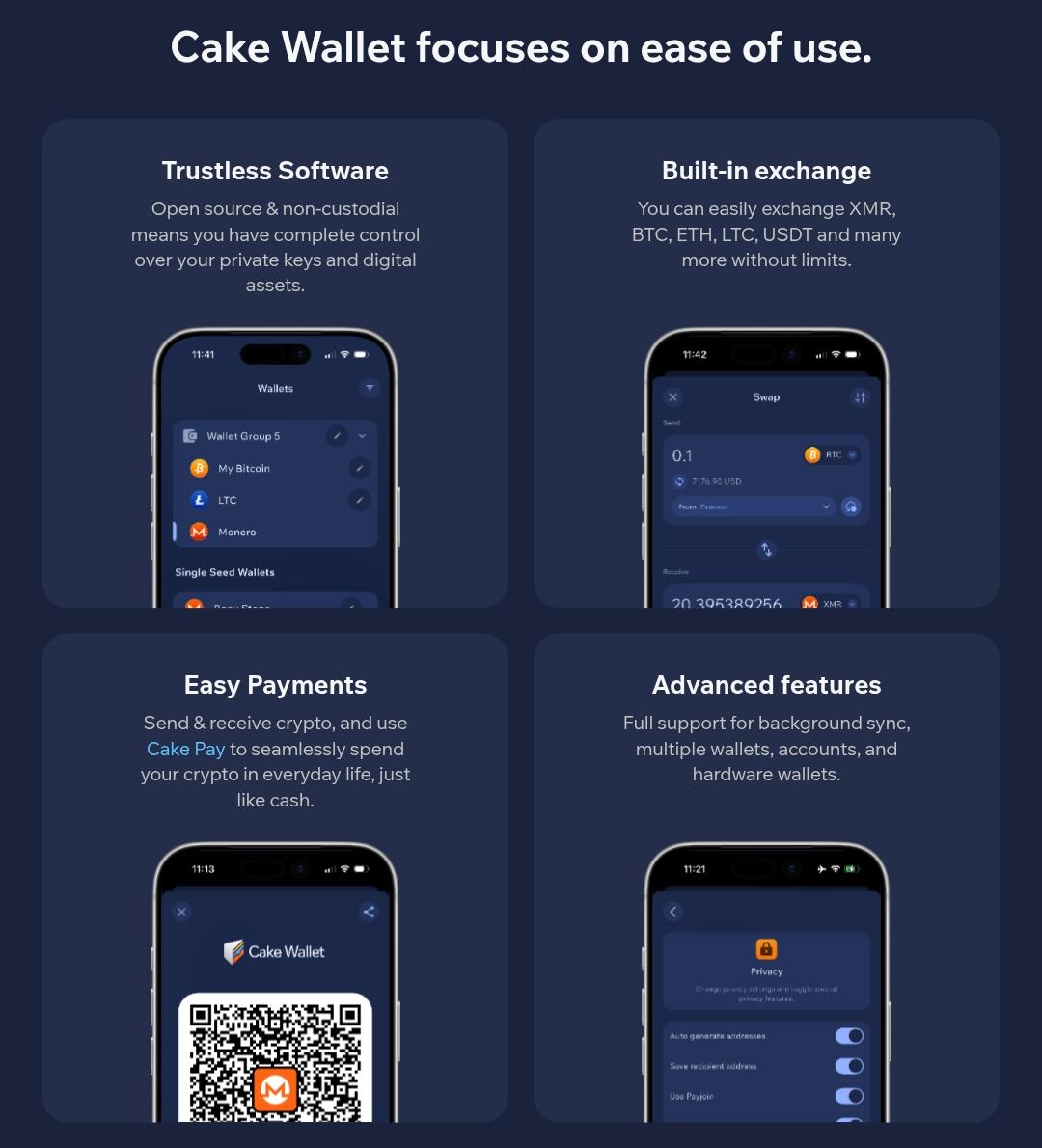
I think the open-source angle matters more than it gets credit for. A wallet claiming strong privacy and security features is a very different claim when the code backing those claims is publicly auditable versus when you’re simply taking a company’s marketing at face value.
How Batch Sending Actually Works
Here’s the feature I think deserves the spotlight: Cake Wallet lets you specify multiple recipients for batch sending in a single transaction, a capability confirmed directly in the project’s own documentation and GitHub repository. Instead of creating five separate transactions to pay five different people, each with its own network fee, its own confirmation wait, and its own chance of getting stuck if network congestion spikes, you bundle every recipient into one transaction that settles as a single unit.
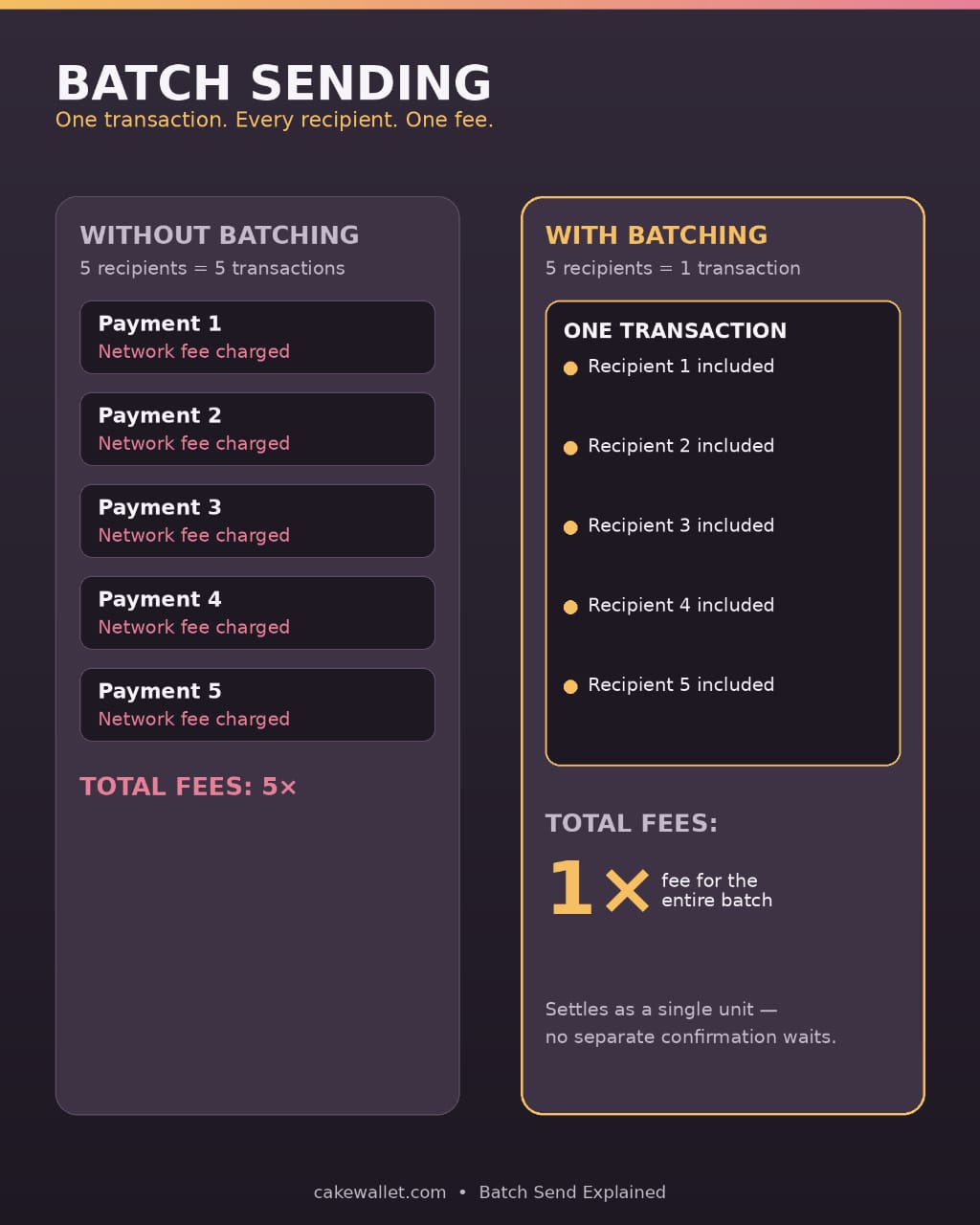
I think the practical value here is obvious the moment you’ve actually needed to pay multiple people at once, whether that’s splitting a bill, paying multiple contractors, or distributing funds across your own set of wallets. On networks where fees spike during periods of congestion, batching isn’t just a convenience. It can mean paying one fee instead of five, since the network charges based on transaction data size and complexity rather than a flat rate per recipient.
The Send Flow, Step By Step
Getting to the send screen in Cake Wallet starts simply: tap Send from the balance screen, then paste a destination address using the paste button, a QR code scan, or your saved address book. From there, you enter an amount either in the active cryptocurrency or its fiat equivalent, and you can send your entire wallet balance at once using the ALL button if needed. You’re also able to adjust the network fee priority, add a private internal note visible only within the app, and confirm the transaction before it broadcasts.
Worth noting for anyone new to this: the network fee is charged separately from your send amount. If your balance is 1 XMR, you’re sending 0.5 XMR, and the network fee comes to 0.01 XMR, your total spend for that transaction is 0.51 XMR, not 0.5. That distinction matters even more when you’re batching, since you’re paying one combined fee across every recipient in that transaction rather than accumulating fees per person as you would sending individually.
Address Flexibility That Goes Beyond Standard Formats
What I think elevates Cake Wallet beyond a basic multi-coin app is how far it goes with address recognition. Beyond standard wallet addresses, Cake Wallet supports sending directly to OpenAlias addresses, ENS domains ending in .eth, and Unstoppable Domains addresses across supported top-level domains, along with FIO Crypto Handles. It even supports typing in a Mastodon or X username directly into the send screen, and if that account has a correctly formatted address posted in its bio or a pinned post for the relevant cryptocurrency, the wallet will surface it automatically.
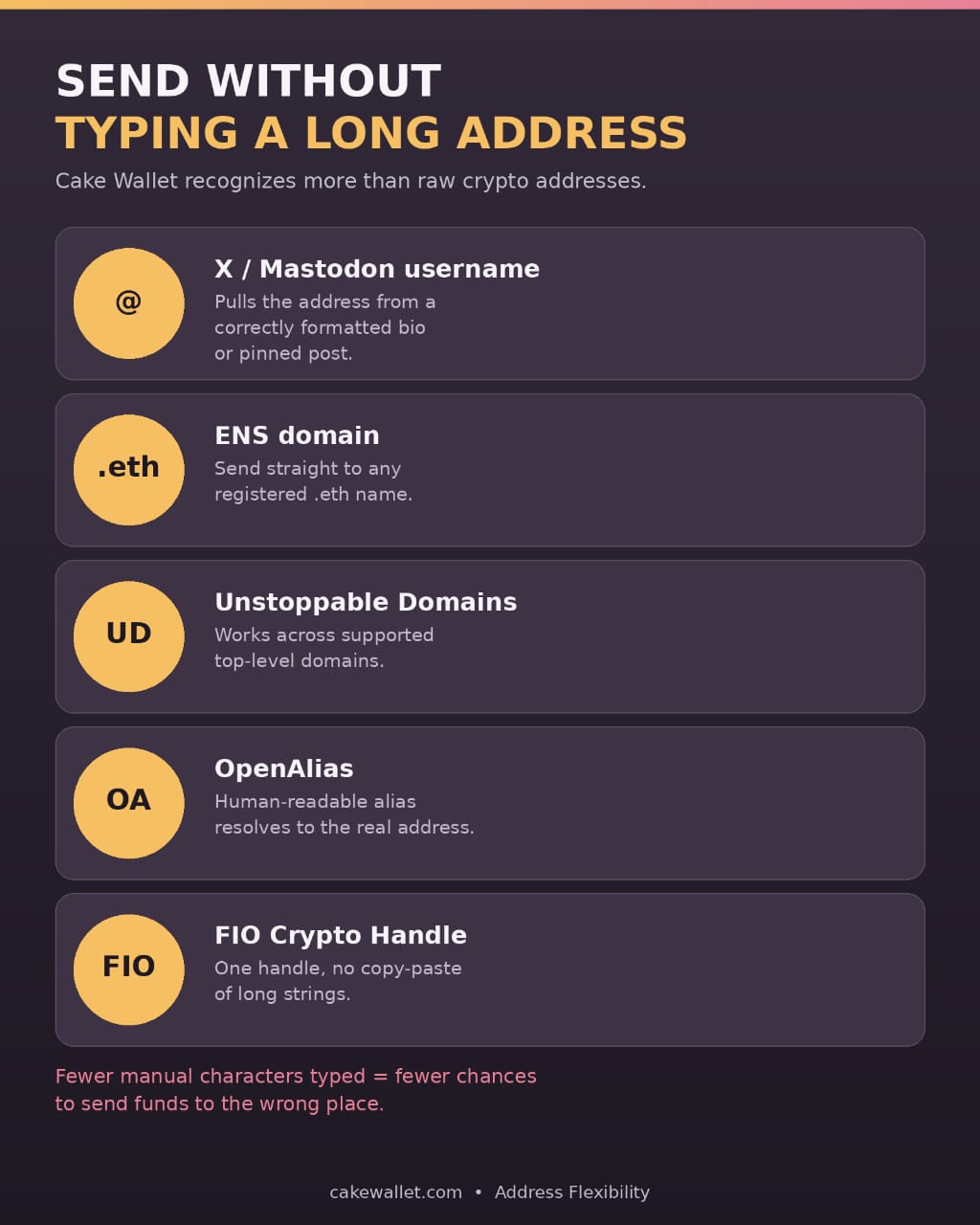
I think this feature set, combined with batch sending, tells a consistent story about what Cake Wallet is actually optimized for: reducing the number of steps and the number of places an error can creep into a transaction. Typing a long, easily mistyped wallet address is one of the most common ways people accidentally send funds to the wrong place. Being able to type a username or domain instead removes a meaningful chunk of that risk entirely.
Privacy Features Built Around Monero
Given how central Monero is to Cake Wallet’s identity, I think its privacy-specific tooling deserves its own mention. The wallet automatically generates new subaddresses after each use by default, a privacy practice that prevents multiple transactions from being easily linked to the same identity on-chain. Advanced users can disable that automatic generation and manage subaddresses manually, and there’s even an option to configure the wallet to discard the recipient address after sending Monero entirely, a setting Cake Wallet explicitly recommends only for advanced users who understand the tradeoff, since doing so means losing any record of who funds were sent to.
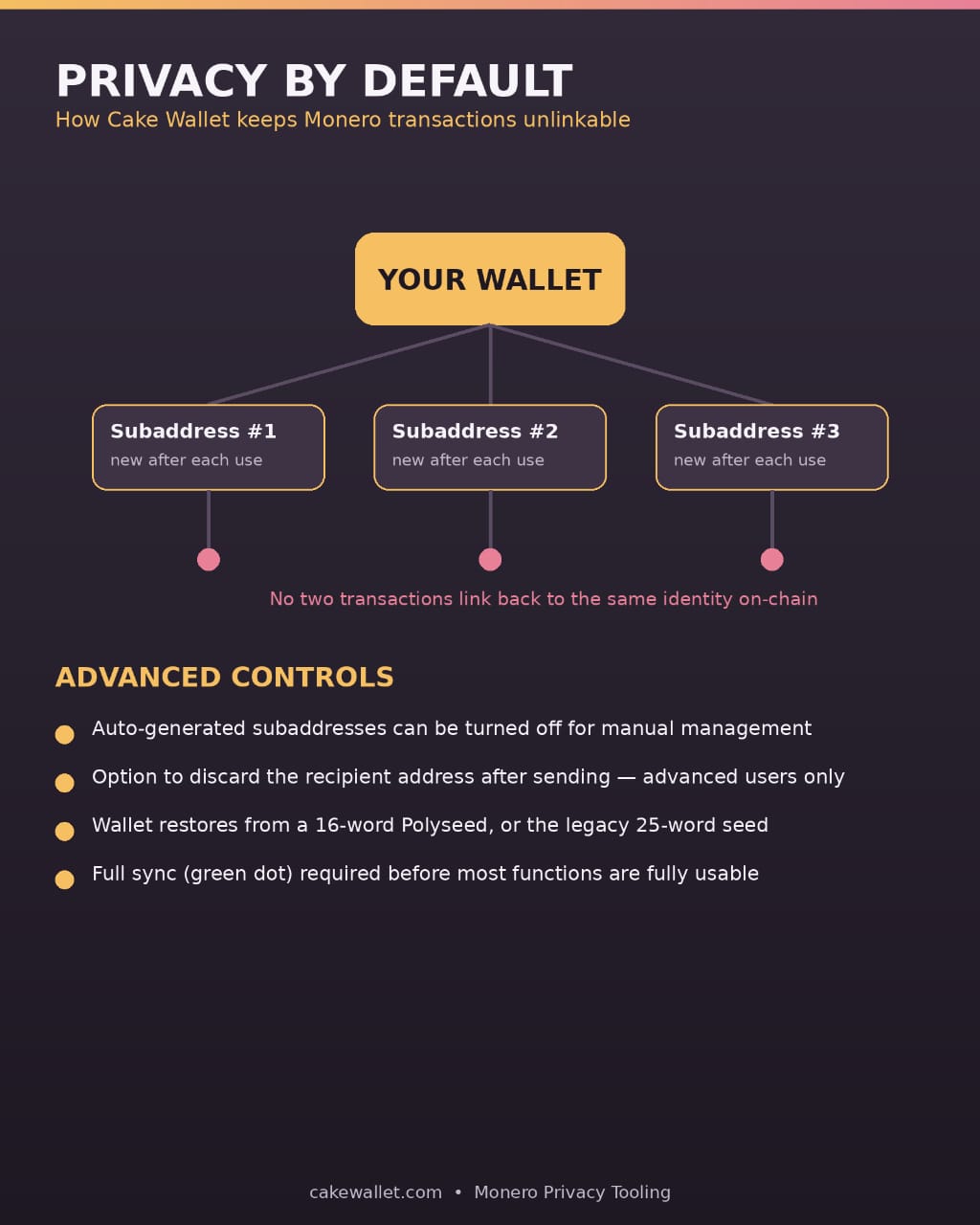
Wallet creation and restoration run on either a 16-word Polyseed by default or the older 25-word legacy seed format, and the wallet requires full synchronization, indicated by a green dot on the home screen, before most functions work properly. I think that sync requirement is a minor friction point worth knowing about upfront, since a newly restored wallet won’t feel fully usable until that sync completes.
Why This Combination Sets Cake Wallet Apart
I don’t think batch sending alone is a revolutionary feature in isolation. Plenty of Bitcoin-focused tools support it in some form. What I think actually sets Cake Wallet apart is combining that fee-saving batch capability with genuinely broad multi-currency support, deep Monero-specific privacy tooling, flexible address recognition across usernames and domains, and a fully open-source codebase anyone can verify, all inside one non-custodial app rather than scattered across five different tools you’d otherwise need to juggle.
For anyone who regularly sends crypto to more than one recipient at a time, whether that’s payroll, recurring group payments, or just consolidating funds across your own wallets, I think batch sending is the kind of feature that quietly saves real money over time in avoided fees, even if it never gets the same marketing attention as flashier additions like Cake Pay. It’s the sort of functionality that matters most once you actually need it, and by then, most other wallets have already made you do it the slow, expensive way for months without you realizing there was a better option available.
Some visuals in this article are AI-generated illustrations created to demonstrate Cake Wallet’s features and are not actual screenshots of the app. For accurate, up-to-date information or to interact directly with the wallet, please visit https://cakewallet.com/.
Disclosure: This is not trading or investment advice. Always do your research before buying any cryptocurrency or investing in any services.
Follow us on Twitter @themerklehash to stay updated with the latest Crypto, NFT, AI, Cybersecurity, and Metaverse news!