

Every blockchain grapples with one big question – How to agree on the truth. Proof of Work (PoW) and Proof of Stake (PoS) are the two warring answers to that question.
Bitcoin’s PoW is the original, a brute-force approach proven by time. And yet, nearly every new blockchain is betting on PoS, chasing a future that’s faster and more efficient.
Their core differences reveal what their creators value most in security, fairness, and performance.
A fight for security – Raw power vs. cold hard cash
Making an attack cost more than it’s worth is the name of the game for any blockchain. PoW and PoS just have completely different ways of raising the price of admission for cheaters.
Proof of Work makes attackers burn real-world energy and buy mountains of hardware. A 51% attack on Bitcoin means out-computing a global network of specialized ASIC machines, an absurdly expensive undertaking. The security is tied directly to consuming immense amounts of electricity.
Proof of Stake flips the script, forcing attackers to buy up a majority of the network’s own currency to gain control. Validators must “stake” a large sum of crypto as collateral to get a chance to process transactions. The killer feature for PoS security is “slashing.” If you’re a validator who tries to cheat, the network automatically burns your staked money. An attacker would literally be destroying their own fortune in the process.
PoW has its own gremlins, like selfish miners who game the system to earn more rewards. PoS, on the other hand, has to worry about “long-range attacks,” where old keys could be used to try and rewrite history from way back.
To stop this, PoS chains rely on checkpoints, essentially asking new users to trust a recent snapshot of the network’s state.
The decentralization paradox
The dream of decentralization has hit some hard realities in both camps.
PoW mining was meant to be for everyone, but it’s become a game for giants. A few massive mining pools, like Foundry USA and AntPool, now control enough computing power to threaten the network. Bitcoin’s Nakamoto Coefficient, the number of players you’d need to collude for an attack, is a shockingly low three.
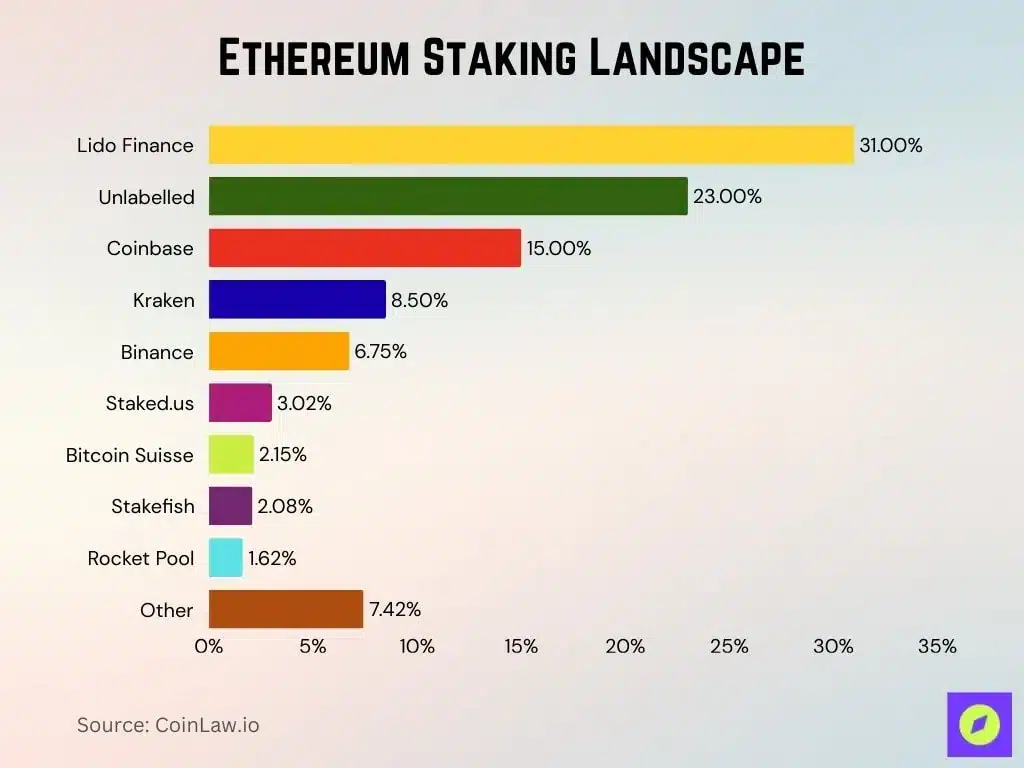
PoS tried to fix this by getting rid of expensive hardware, but money still attracts money. To be a solo validator on Ethereum, you need 32 ETH – A price that has pushed most people into staking pools and liquid staking protocols. The giant liquid staking service Lido now holds so much ETH that it’s become its own point of centralization, dragging Ethereum’s Nakamoto Coefficient down to a scary two.
Source: CoinLaw.io
Performance and the new breed of blockchains
When it comes to speed, there’s no contest – New projects have almost universally abandoned PoW.
Bitcoin chugs along at about 5-7 transactions a second, with a ten-minute wait for a new block. PoS chains spit out blocks in seconds, which is why Ethereum’s switch to PoS was the first step toward its goal of massive scaling.
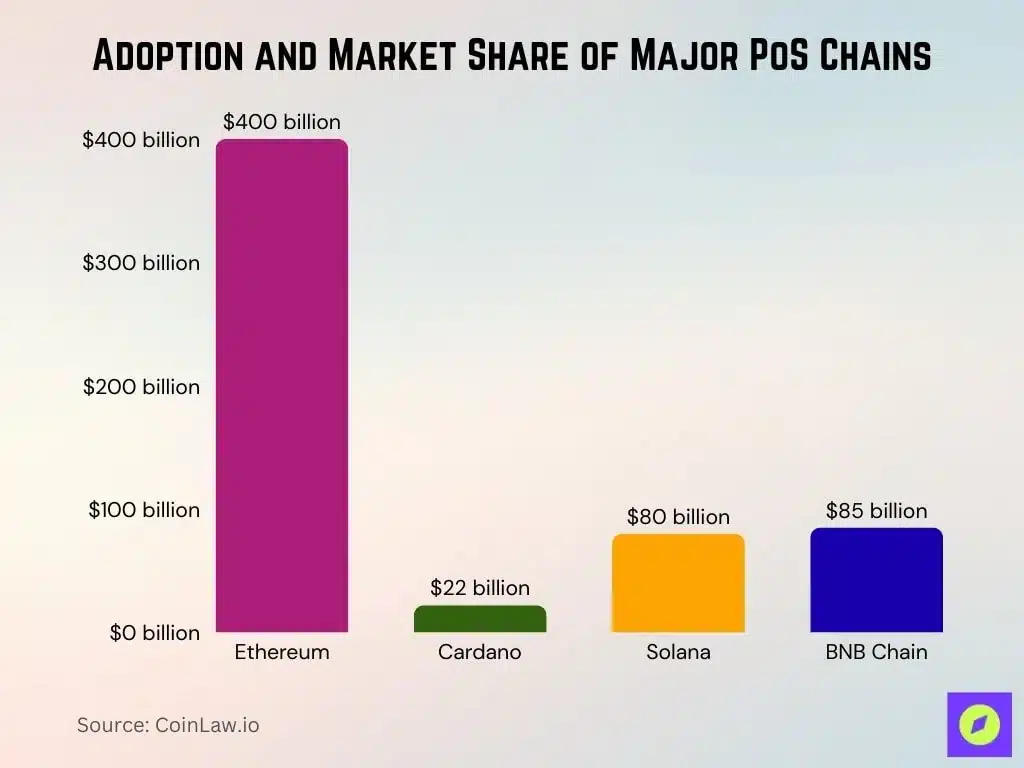
Newer chains didn’t even bother with PoW; Solana uses a ‘Proof of History’ twist on PoS to hit thousands of transactions per second, while projects like Sui and Avalanche are built from the ground up for high-speed uses.
However, don’t count PoW out just yet. A project called Kaspa is using a structure called a blockDAG, a spin on the blockchain, that lets it process blocks in parallel and hit speeds that rival PoS chains – A sign that the old model still has some new tricks.
Economics of security – Who pays the guards?
How you pay for security over the long haul is where PoW and PoS really diverge.
PoW chains like Bitcoin pay miners with new coins and transaction fees. However, the new coins, the “block subsidy,” get cut in half every four years in events called “halvings.” Eventually, the network will have to survive on transaction fees alone. Critics worry that if those fees aren’t high enough, the incentive to secure the chain could dry up.
PoS systems usually just build in a small, steady rate of inflation to pay validators forever, supplemented by transaction fees. While that sounds like it devalues the currency, tricks like burning transaction fees, which Ethereum’s EIP-1559 made famous, can actually make the supply shrink over time.
Source: CoinLaw.io
Environmental questions and the eye of the regulator
The elephant in the room for PoW is its gigantic energy bill.
Bitcoin’s electricity use rivals that of small countries, drawing fire from environmentalists and politicians. Ethereum’s move to PoS, “The Merge,” slashed its energy footprint by over 99.9% almost overnight. A single transaction on Ethereum is now worlds cleaner than one on Bitcoin.
Regulators have taken notice. The EU is now forcing crypto companies to report their environmental damage under its MiCA law. And, New York has even put a temporary ban on some PoW mining operations.
PoS has its own regulatory headaches, mostly centered on whether staking looks like an investment contract. The U.S SEC gave the industry some breathing room in 2025, clarifying that some liquid staking services aren’t securities. All while Europe’s MiCA rules are mainly concerned with services that hold staked assets for customers.
A clash of philosophies
PoW versus PoS isn’t just about code; it’s about two different worldviews. PoW believes security must be earned with raw energy and physical work, a concept called “unforgeable costliness.” PoS trusts that putting enough capital on the line creates a system where everyone’s financial self-interest keeps the network honest.
New projects are clearly voting with their feet for the speed and low energy costs of PoS. But the sheer, battle-hardened resilience of Proof of Work means it isn’t going anywhere. This isn’t a battle with a single winner.
We’re heading toward a future with a whole zoo of consensus models, each built for a different purpose and trade-off.