
Privacy coins are designed to provide the financial privacy that most mainstream blockchains fail to offer.
While many assume their transactions are anonymous, standard public ledgers allow for tracking on a transparent scale. This lack of true confidentiality is why privacy coins remain relevant.
Monero (XMR) and Zcash (ZEC) aim to solve these transparency issues, but they follow fundamentally different paths. This difference dictates everything from how you interact with the network to how exchanges handle your assets.
Ultimately, the debate comes down to a simple trade-off:
- Privacy by default
- Privacy by choice
Let’s compare!
Key highlights:
- Monero (XMR) ensures mandatory privacy by hiding the sender, receiver, and transaction amount on every transfer by default
- Zcash (ZEC) utilizes optional privacy, providing strong security only when users choose to initiate shielded transactions
- Because of its default privacy model, Monero (XMR) maintains a larger practical anonymity set and superior fungibility
- Zcash (ZEC) holds a distinct advantage for users who require selective disclosure, third-party audits, or broad support from regulated platforms
- If your primary goal is achieving pure on-chain privacy, the crypto community generally considers Monero (XMR) to be the stronger pick
How Monero (XMR) and Zcash (ZEC) solve financial privacy
Bitcoin changed how we handle money on the internet, but it failed to provide true confidentiality. Its ledger is public, permanent, and susceptible to blockchain surveillance once addresses are linked to real-world identities.
Monero (XMR) and Zcash (ZEC) exist to solve the inherent flaws of transparent ledgers.
Why financial privacy matters
Crypto users often realize the lack of security too late. A wallet address might appear anonymous at first, but the blockchain is a permanent record. Once a single address is tied to your identity, your entire transaction history becomes exposed to blockchain forensics and surveillance.
Financial privacy is non-negotiable. You likely don’t want your salary history exposed to the public. Businesses may want to protect vendor data, treasury movements, or customer payments from competitors.
Also, donors, activists, journalists, and high-net-worth individuals often require basic personal safety that standard blockchains cannot provide.
The big idea behind each coin
In short, Monero (XMR) focuses on mandatory privacy. With this approach, every transaction automatically obscures the sender, receiver, and amount. There is no transparent mode to fall back on, ensuring that no user accidentally compromises their own data.
Zcash (ZEC) prioritizes optional privacy. It supports transparent addresses, known as t-addresses, alongside shielded addresses, known as z-addresses. If users choose shielded transactions, the details remain private. If they don’t, the transaction remains public, functioning much like Bitcoin.
That singular design choice defines the ongoing contest between these two digital assets.
Privacy Tech: zk-SNARKs vs Ring Signatures
On a fundamental level, the split between Monero (XMR) and Zcash (ZEC) looks like this:
| Feature | Monero (XMR) | Zcash (ZEC) |
| Privacy mode | Always on | Optional |
| Main tools | Ring signatures, stealth addresses, RingCT | zk-SNARKs |
| Transparent layer | None | Yes, via t-addresses |
| Private layer | Every transaction | Shielded pool, via z-addresses |
| Disclosure options | No public transaction mode | View keys and selective disclosure |
That first row, always on versus optional, is the root of almost every other difference between Monero and Zcash.
How Monero hides every transaction by default
Monero (XMR) uses three core tools together to ensure user anonymity.
- First, ring signatures mix your real transaction input with decoy inputs. By using ring signatures, the network makes sure that anyone looking at the chain sees a group of possible signers, not a clean fingerprint pointing to one wallet.
- Second, stealth addresses create a one-time address for every payment. These stealth addresses ensure the recipient’s public wallet address never appears directly on-chain for that transaction.
- Third, RingCT, short for Ring Confidential Transactions, hides the amount being sent. So the chain cannot show who paid, who received, or how much moved.
By combining these features, the network achieves total transaction untraceability. Monero also uses Dandelion++ to make network tracing harder at the broadcast level. That doesn’t replace on-chain privacy, but it adds another layer.
In practice, Monero (XMR) removes the option to forget privacy. Every transaction uses the same private rules. Most 2026 Monero versus Zcash comparisons focus on that, because it’s the cleanest way to explain why Monero privacy feels stronger in real use.
How Zcash uses zero-knowledge proofs
Zcash (ZEC) takes a different route. Its privacy engine is built on zk-SNARKs, which is short for zero-knowledge succinct non-interactive arguments of knowledge.
The phrase is a mouthful, but the idea is simple. These zero-knowledge proofs let the network verify that a transaction is valid without revealing the:
When Zcash (ZEC) users engage in shielded transactions from one z-address to another, the details stay hidden inside the shielded pool. However, transparent transactions still exist on the network. A payment made via transparent transactions remains fully visible to the public.
While Zcash provides powerful privacy through zk-SNARKs, moving funds into or out of the shielded pool can sometimes expose clues.
That optional model is getting more real in 2026. As of the middle of 2026, about 30% of ZEC supply sat in shielded addresses, a record high and a sign that private use is not just theoretical.
Why default privacy changes the whole game
This is the part that decides the winner for many privacy-first users.
Privacy doesn’t only depend on math. It also depends on the size of the crowd you can hide inside. That’s the anonymity set.
In privacy systems, the crowd matters as much as the cloak.
Monero’s crowd is larger because nearly every transaction is private. There is not a transparent pool separating private users from public users. That makes Monero stronger on fungibility too. One XMR is much harder to judge by its history because the history is hidden.
Zcash can produce excellent privacy inside shielded transactions. But optional privacy creates a practical weakness. If many users stick to transparent transactions, the shielded users can stand out more.
That is why some 2026 winner debates keep circling back to the same point. The best privacy tech still depends on how many people use it.
Monero vs Zcash regulation, cryptocurrency exchanges, compliance
Strong privacy on paper is one thing, but using a coin in the real world is another. This is where Monero (XMR) and Zcash (ZEC) stop looking like twins.
With the potential implementation of Central Bank Digital Currencies (CBDCs), interest in privacy coins continues to climb as a method to maintain financial sovereignty.
Ease of use, wallet support, and sending coins
Monero (XMR) is simple in one sense and rigid in another. If you use Monero (XMR), privacy is always active. You do not have to choose between public and private modes, which removes the possibility of user error. For privacy-first users, that is a significant benefit.
Zcash (ZEC) gives you more control. If you need a visible transfer for bookkeeping, audits, or simple public payments, transparent addresses are available. That is convenient, but choice can also create friction, because users have to decide which type of address to use and whether their wallet or service fully supports shielded transactions.
XMR vs ZEC: which coin is better for beginners?
For beginners, the learning curve is a primary concern.
Monero requires users to handle larger transaction sizes due to its privacy tech, which can sometimes lead to longer sync times for desktop wallets.
However, because its privacy is mandatory, beginners are less likely to accidentally leak their data by sending funds to a transparent address.
Zcash offers more versatility for beginners who may need to move funds between different wallet types, but this complexity can be daunting. You must learn the difference between transparent and shielded addresses to make sure you’re actually using the privacy features you signed up for.
If a beginner is looking for a “set it and forget it” experience, Monero (XMR) is generally more straightforward.
Cryptocurrency exchanges, compliance, and legal pressure
This is where the US angle matters. Crypto exchanges and payment platforms face strict KYC/AML procedures, the Travel Rule, and growing regulatory scrutiny regarding transaction visibility.
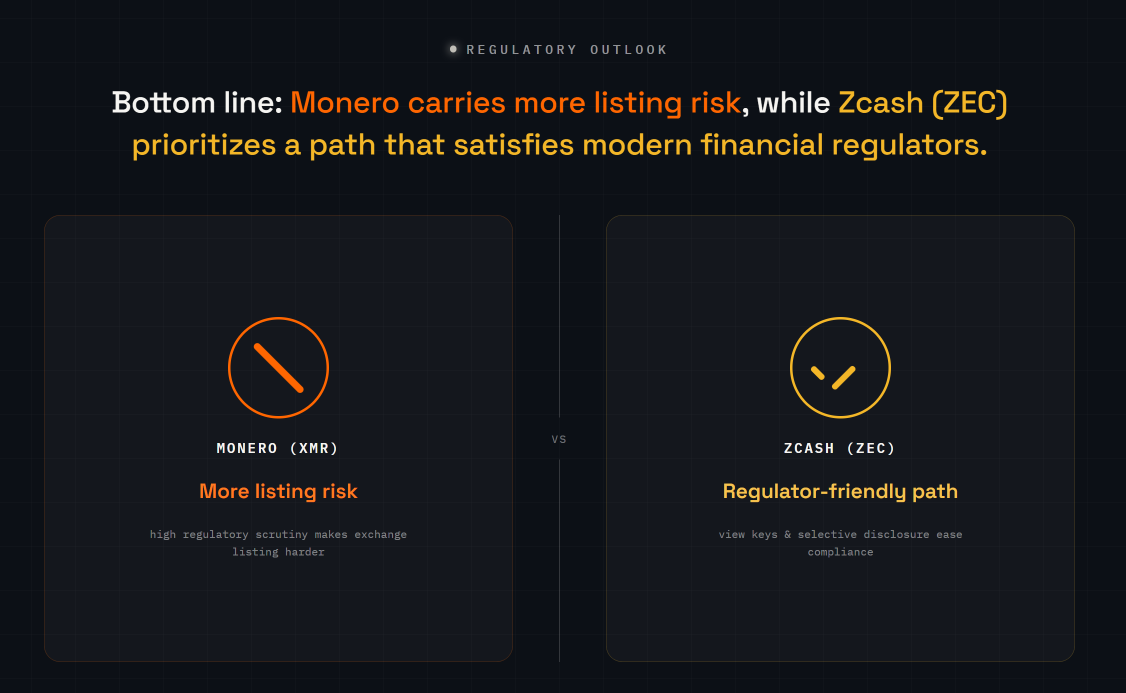
Monero often runs into harder resistance from crypto exchanges because it doesn’t offer a public, Bitcoin-like transaction path.
Zcash has a more compliance-friendly story. Its shielded system can stay private, but users can also use view keys and selective disclosure when they need to prove a source of funds or show activity to an auditor, bank, or compliance team. That flexibility is a major reason why Zcash is usually easier for regulated crypto platforms to support.
Zcash is more favorable compliance-wise because it allows for conditional transparency. Monero does not offer that same public-mode option. That makes it stronger as a pure privacy tool, but tougher to maintain on mainstream platforms.
While high regulatory scrutiny makes listing risky for privacy-focused assets, Zcash keeps trying to balance user privacy with mandatory KYC/AML procedures.
Speed, fees, and network activity in 2026
Both coins rely on Proof-of-work (PoW). Neither is chosen because it looks trendy or because it promises staking yield.
Zcash has a faster target block time, about 75 seconds. Monero (XMR) targets about 2 minutes. Fees on both networks are usually low enough that cost is not the primary issue for most users.
What matters more is how privacy shows up in actual activity. Monero’s private design applies to every transfer. Zcash (ZEC) still splits activity between transparent and shielded use, even though shielded adoption has improved.
So yes, speed and fees matter. But they don’t decide this matchup.
Zcash vs Monero: which coin belongs on the crypto privacy throne?
If you are wondering about the definitive winner in the debate of Monero vs. Zcash: Which Coin Belongs on the Crypto Privacy Throne?, the answer depends on your specific priorities.
- If your goal is to obtain the strongest practical privacy on-chain, Monero is the superior choice
- If you prefer privacy tools that allow for audits, selective disclosures, and broader exchange access, Zcash has the advantage
Choose Monero (XMR) if privacy comes first
Monero is great for users who demand the strongest default privacy and the largest usable anonymity set. It’s also the better option for individuals who do not want to worry about toggling settings or accidentally sending a public transaction.
This universal privacy is why the project continues to hold the crown for many privacy-focused users in 2026.
Every transfer hides sensitive details, every user adds to the same private crowd, and every coin is more fungible because transaction history remains obscured by design. If privacy is the primary goal, Monero remains the most consistent choice.
Choose Zcash (ZEC) if flexibility matters more
Zcash is better when privacy is a high priority, but not the only objective. This includes users who may require third-party audits, institutions that need selective disclosure features, and traders who want a better chance of keeping assets listed on regulated trading venues.
Zcash offers optional privacy. You get protection within shielded transactions while still permitting transparent activity when it simplifies compliance or user experience.
While it may not provide the same default privacy as its competitor, it offers significantly more flexibility.
Assessing future-proof security
When comparing the technical roadmaps of these assets, people often wonder about quantum resistance as a key security metric.
Currently, neither Monero nor Zcash features post-quantum security as a native protocol defense. Both development teams acknowledge this as a critical priority and have outlined theoretical roadmaps to integrate quantum-resistant signatures in the future.
The bottom line: Zcash vs Monero depends on the type of privacy you want
When comparing these privacy coins, the outcome depends entirely on your specific goals.
Monero remains the industry leader for pure anonymity, relying on sophisticated cryptographic techniques that ensure transactions are untraceable by default. While darknet markets and privacy-conscious users often prefer Monero for its consistent security model, it remains a purist tool that avoids the complexities of regulated finance.
Zcash offers a different value proposition. By providing optional transparency and view keys, Zcash (ZEC) combines total anonymity and the utility required for regulated environments.
Both of these privacy coins utilize advanced cryptographic techniques to secure data, yet they serve different segments of the market. This reflects a fundamental philosophical divide in the blockchain space.
Ultimately, Monero represents mandatory privacy, whereas Zcash represents optional privacy.
Frequently Asked Questions
Is it illegal to use Monero or Zcash?
Using privacy coins like Monero (XMR) and Zcash (ZEC) is generally legal in most jurisdictions, as they are tools for financial confidentiality rather than prohibited activities.
However, regulatory scrutiny is high, and some countries have placed restrictions on centralized exchanges that list these assets due to compliance concerns.
What happens if I send Zcash from a transparent address to a shielded one?
When you move funds from a transparent address to a shielded address, the transaction effectively enters the shielded pool where the transaction details are obfuscated.
But an observer can still see the fact that funds moved from a public source into the private pool, which can sometimes provide clues about the origin of those funds.
Can Monero transactions be traced by law enforcement?
To the best of public knowledge, no. The architecture of Monero (XMR), which includes ring signatures and stealth addresses, is designed to ensure that transactions are untraceable and non-linkable by default.
While blockchain analysis firms continuously attempt to develop new tracking methods, this coin currently maintains a high standard of on-chain privacy that prevents the public monitoring seen on networks like Bitcoin or Ethereum.