Bitcoin has made some early investors very wealthy. A person who put $10,000 into Bitcoin in October 2016, when it traded near $657, would hold about $1.24 million in October 2026. That assumes they never sold.
That is a gain of more than 12,300%. It works out to a compound annual growth rate of about 62% over ten years.
Many readers now ask if the next ten years can look the same. The starting point is very different. In October 2016, the whole Bitcoin network was worth about $10.5 billion.
Today its market value is about $1.64 trillion, so Bitcoin is more than 150 times larger. A better question is what yearly return Bitcoin would need to turn an ordinary investment into serious wealth. This article uses simple math to answer it.
Bitcoin’s Starting Point in 2026
On October 23, 2026, Bitcoin trades near $81,700. Its market capitalization is about $1.64 trillion. About 20.1 million BTC are in circulation, out of a maximum supply of 21 million.
Bitcoin is also about 35% below its October 2025 all-time high of roughly $126,198. That sets up a different picture for buyers today than for early buyers.
| Measure | October 2016 | October 2026 |
|---|---|---|
| Bitcoin price | $657 | $81,700 |
| Market capitalization | About $10.5 billion | About $1.64 trillion |
| Coins in circulation | Not listed in sources | About 20.1 million |
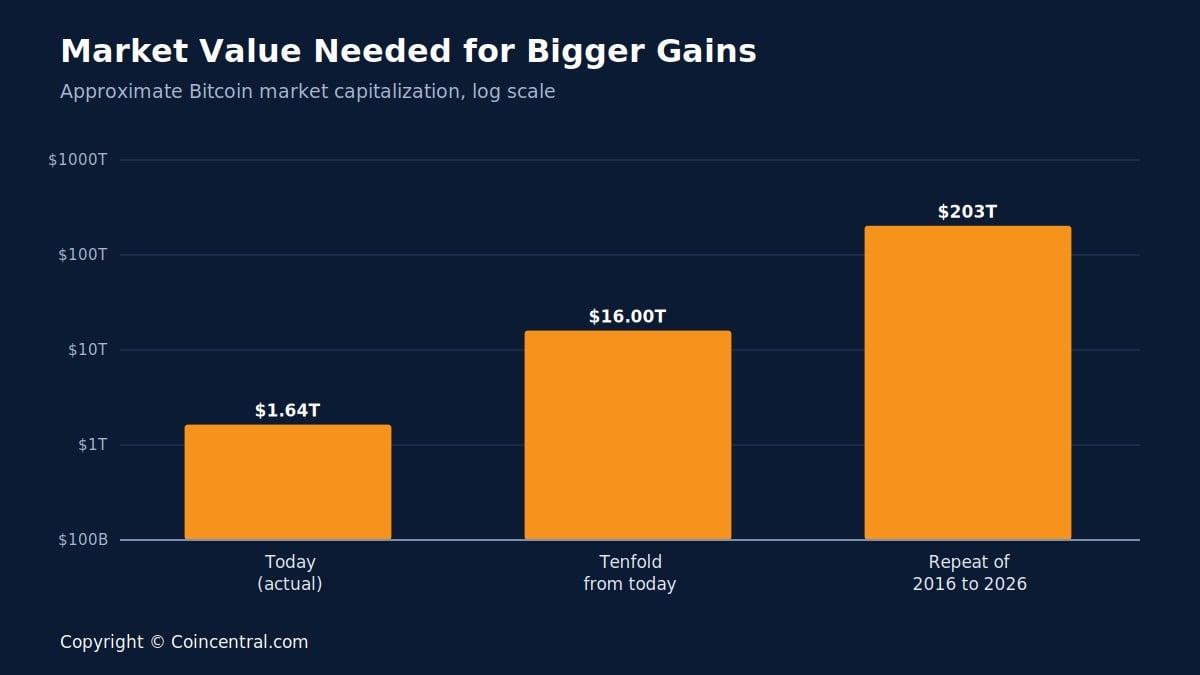
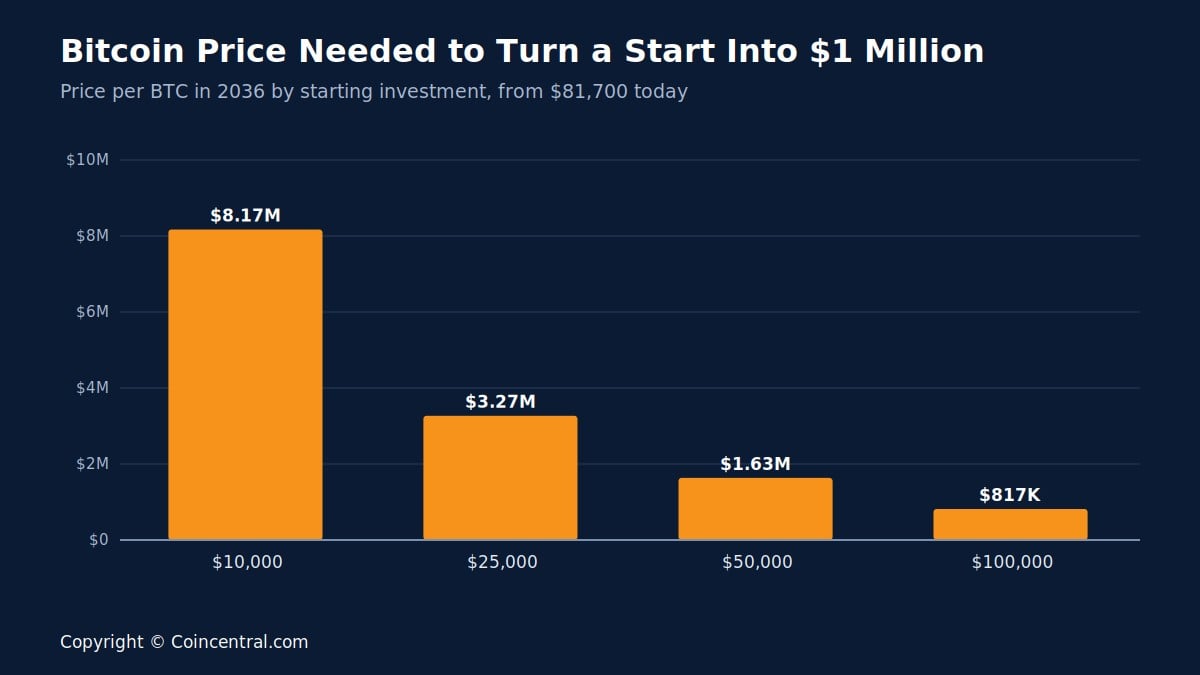
Buying Bitcoin now is not the same as buying when the whole network was worth $10 billion. For the price to rise tenfold, it would need to reach about $817,000 per coin.
At today’s supply, that price would mean a market value near $16 trillion. That is possible in math terms. It is a much bigger economic hurdle than Bitcoin faced in its early years.
Size matters for returns. When a small asset grows, a modest amount of new money can move the price a lot. When an asset is worth trillions, it takes far more money to push the price the same percentage.
What Happens to $10,000 Over 10 Years?
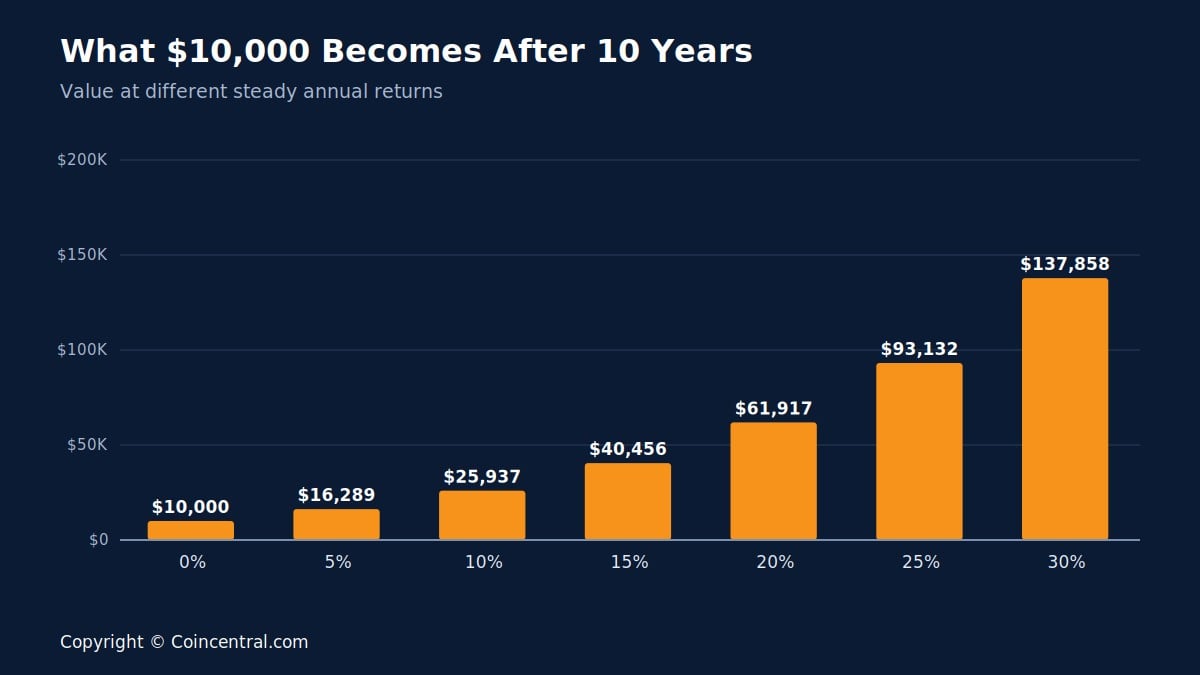
Start with a simple $10,000 investment. The table shows what it would become after ten years at different steady yearly returns.
| Annual return | $10,000 after 10 years |
|---|---|
| 0% | $10,000 |
| 5% | $16,289 |
| 10% | $25,937 |
| 15% | $40,456 |
| 20% | $61,917 |
| 25% | $93,132 |
| 30% | $137,858 |
Strong returns do not always turn a small amount into a fortune. A 20% yearly return for ten years would be high by usual investing standards. Even so, $10,000 would grow to only about $62,000.
At 30% a year, it would reach about $138,000. Reaching $1 million from a small sum takes more time, more starting money, very high returns, or regular added savings. Most paths need a mix of all four.
The 0% row is a useful baseline. Every other row depends on Bitcoin’s price actually rising over the period. Nothing in the table is guaranteed.
How Much Would $50,000 or $100,000 Become?
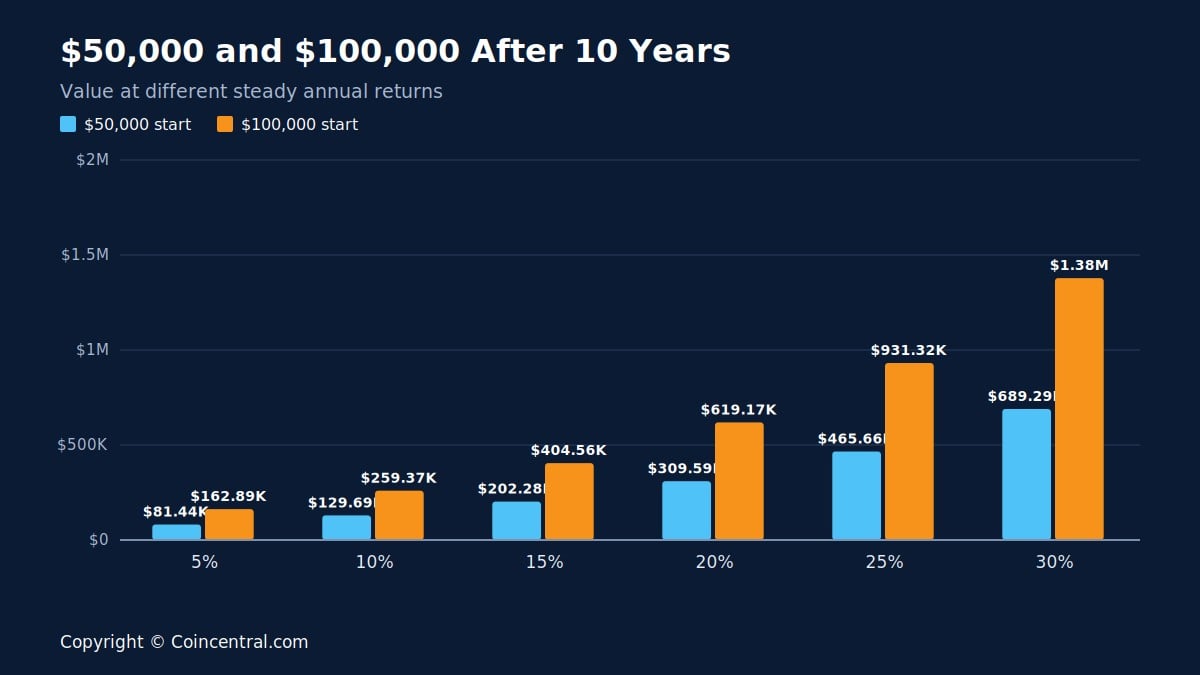
More starting money changes the result. The table applies the same return rates to $50,000 and $100,000.
| Annual return | $50,000 after 10 years | $100,000 after 10 years |
|---|---|---|
| 5% | $81,445 | $162,889 |
| 10% | $129,687 | $259,374 |
| 15% | $202,278 | $404,556 |
| 20% | $309,587 | $619,174 |
| 25% | $465,661 | $931,323 |
| 30% | $689,292 | $1.38 million |
At a 25% yearly return, $50,000 grows to about $466,000. That is just short of half a million dollars. At 30%, it nears $690,000.
With $100,000, the picture shifts. At about 25.9% a year, the money reaches $1 million after ten years. That is the first realistic millionaire path in these numbers.
The gap between the two columns is simple. Doubling the starting amount doubles the ending value at every return rate. Both the return you earn and the money you start with drive the result.
What Return Do You Need to Reach $1 Million?
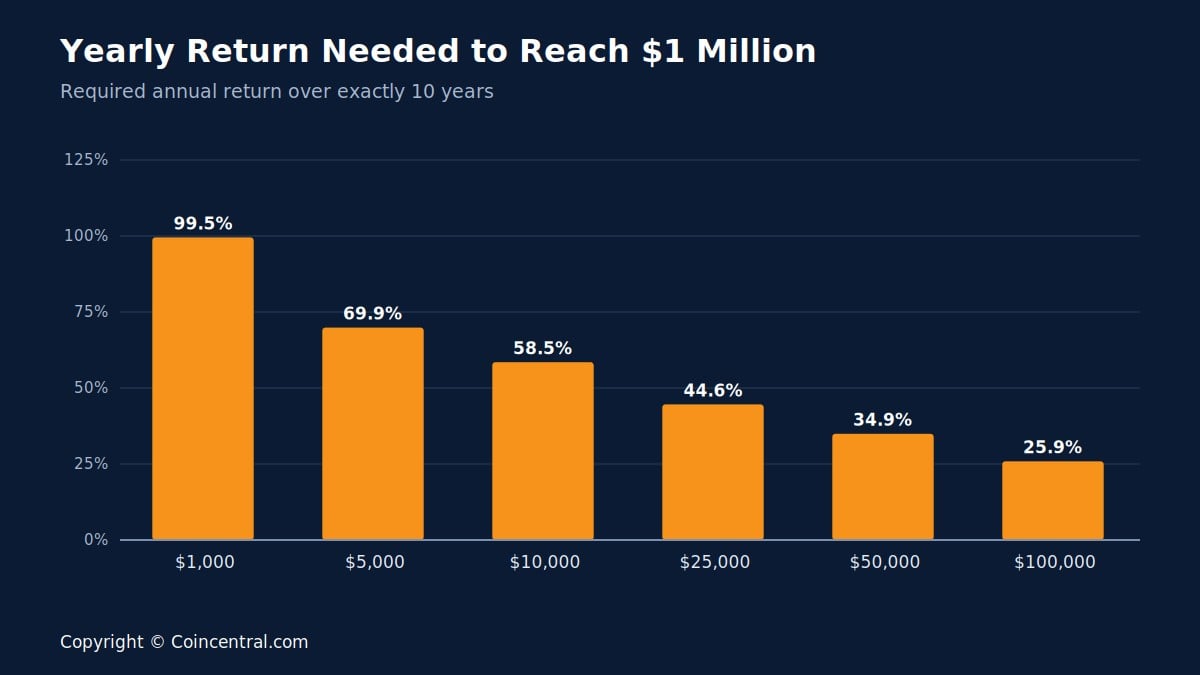
The return you need depends on how much you start with. The table shows the yearly return needed to reach $1 million in exactly ten years.
| Starting investment | Required annual return |
|---|---|
| $1,000 | 99.5% |
| $5,000 | 69.9% |
| $10,000 | 58.5% |
| $25,000 | 44.6% |
| $50,000 | 34.9% |
| $100,000 | 25.9% |
A person who invests $1,000 would need Bitcoin to nearly double every year for ten years. That means a 1,000-fold gain. The implied Bitcoin price would be about $81.7 million per coin.
That is not a reasonable base case. A person with $100,000 needs about 25.9% a year, or roughly a tenfold gain. That points to a price near $817,000, which is still a bullish call but far easier to picture.
Put another way, the table shows a trade-off. Less starting money means you must hope for a much higher return. More starting money lets you reach the same goal with a return that is easier to believe.
What Bitcoin Price Would Different Returns Produce?
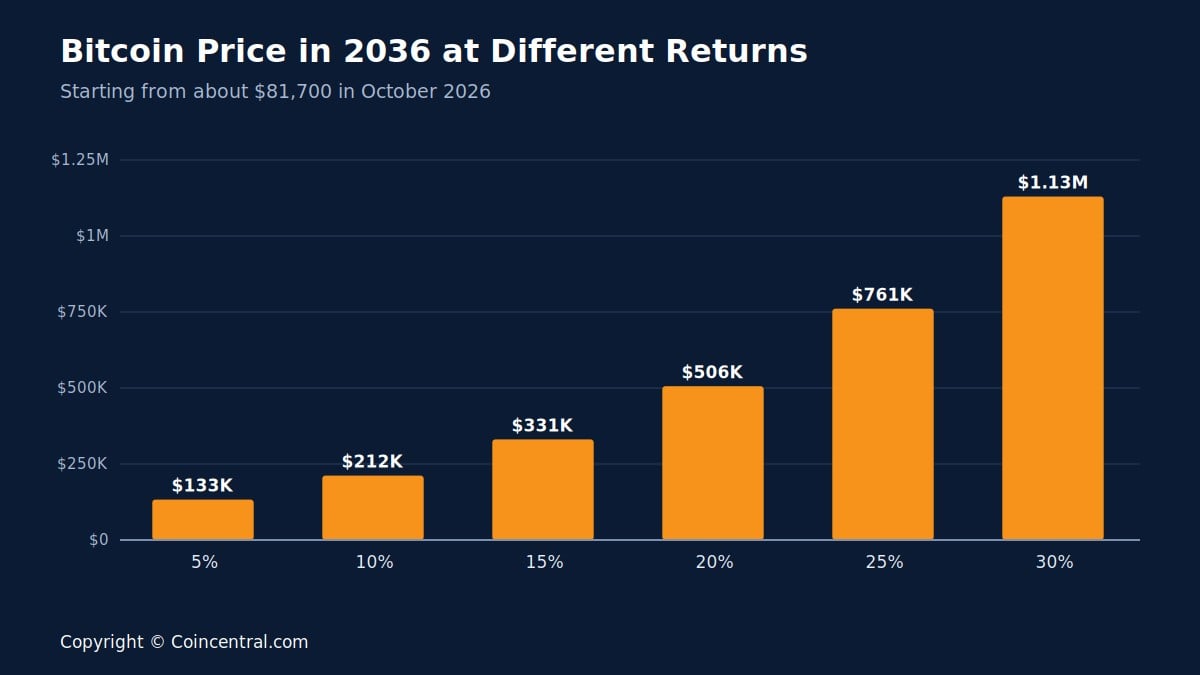
Starting from about $81,700, ten years of steady growth gives the prices below. Market values use today’s circulating supply to keep the math simple.
| Annual BTC growth | Bitcoin price in 2036 | Approx. market cap |
|---|---|---|
| 5% | $133,000 | $2.7 trillion |
| 10% | $212,000 | $4.3 trillion |
| 15% | $331,000 | $6.6 trillion |
| 20% | $506,000 | $10.2 trillion |
| 25% | $761,000 | $15.3 trillion |
| 30% | $1.13 million | $22.6 trillion |
A call for $1 million Bitcoin sounds dramatic. In economic terms, it implies a network worth more than $20 trillion. That would place Bitcoin among the largest pools of wealth in the world.
It is not impossible. It would need Bitcoin to play a much bigger role in global finance than it does today.
Bitcoin also does not need to repeat its past 60% yearly return to reach seven figures. Going from $81,700 to $1 million is a gain of about 12.2 times. Over ten years, that is about 28% a year.
Using the same supply for every row is a simplification. New coins are still being issued, so the real supply in 2036 will be a little higher. The effect on the market values is small.
Could Bitcoin Return 20% a Year?
No one knows. History gives some context. Fidelity Digital Assets reported in 2026 that Bitcoin had positive calendar-year returns in seven of the previous ten years, and negative returns in three.
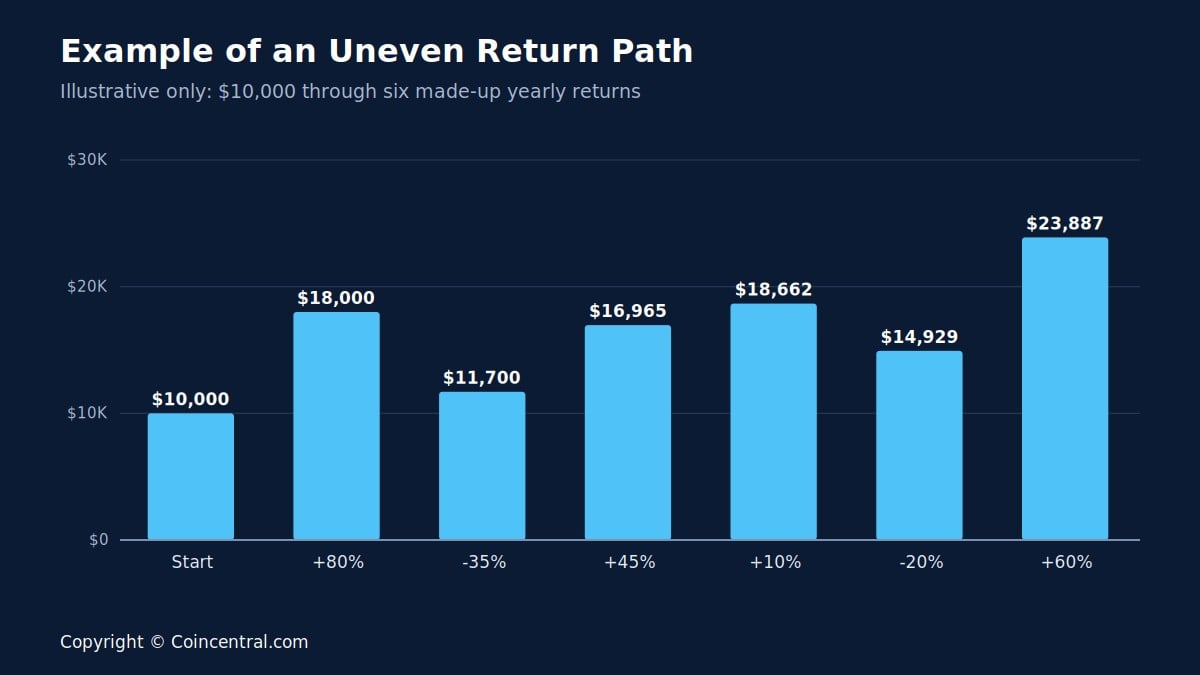
A 20% compound return does not mean a 20% gain each year. The path could look more like +80%, -35%, +45%, +10%, -20% and +60%. The math only tracks the ending value.
The chart shows an example path. It is made up for illustration and is not a forecast. A $10,000 investment ends this run near $23,900, with several sharp drops along the way.
Many investors will not hold through repeated drops of 30% to 70%. The path matters for behavior as much as the final number.
Tables like these do not predict the future. They answer a narrower question. If Bitcoin returns a set percentage each year, what happens to the money?
Bitcoin’s Large Drawdowns
Compound return tables make growth look smooth. Bitcoin has not been smooth. Fidelity Digital Assets notes that Bitcoin has had several drawdowns of 40% to 70%, and earlier cycles saw falls of 80% or more.
Fidelity’s February 2024 analysis showed the previous cycle falling about 75% from its all-time high. More recently, Bitcoin fell roughly 50% from its October 2025 high before recovering part of the drop.
BlackRock said in August 2026 that this sell-off reflected deleveraging among crypto-native traders and changing investor flows. It argued that this was not damage to Bitcoin’s long-term thesis. Whether that view proves right is uncertain.
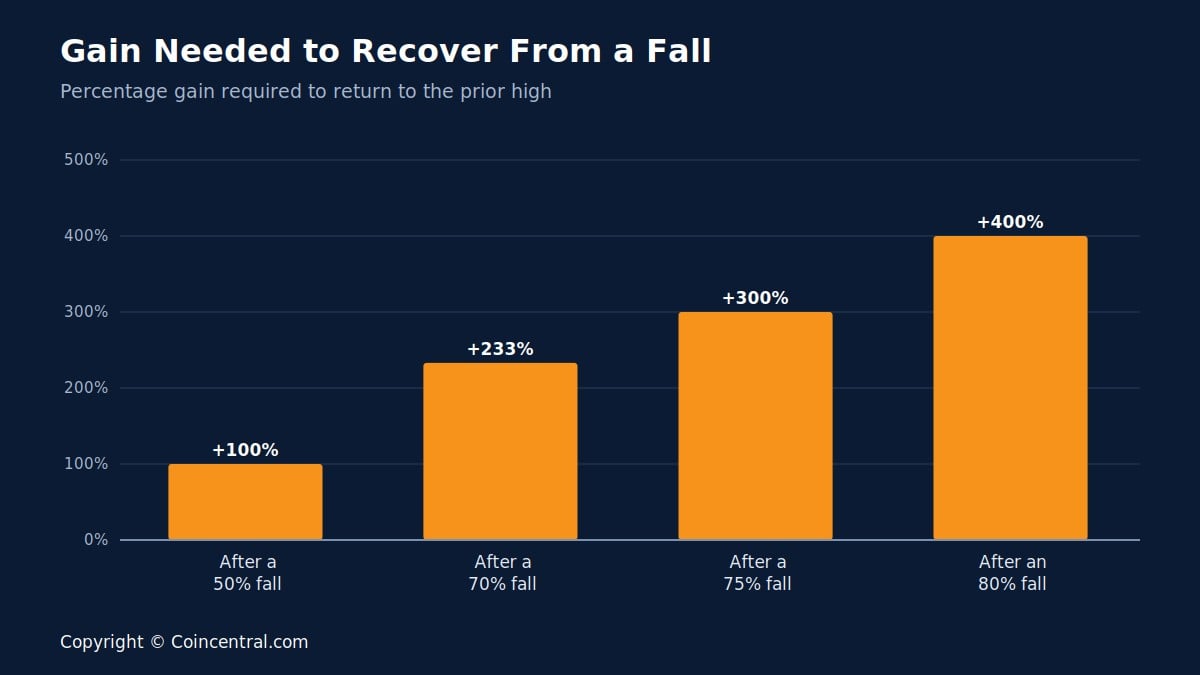
| Price fall | Gain needed to recover |
|---|---|
| 50% | 100% |
| 70% | 233% |
| 75% | 300% |
| 80% | 400% |
Loss math is harsh. A 70% fall needs a 233% gain just to get back to even. This is one reason investors who panic sell can earn far less than Bitcoin itself over the same period.
Drawdowns also test patience. Someone who bought near a peak could wait years just to break even. Some investors give up before the recovery arrives.
Why the Next Decade May Not Match the Last
Bitcoin traded near $657 on October 23, 2016. Today it trades near $81,700. Repeating that 124-fold rise would put Bitcoin above $10 million per coin.
The implied market value would pass $200 trillion. That would be a very large share of global financial wealth.
This is the law of large numbers. It is easier for an asset worth $10 billion to grow to $100 billion than for one worth $1.6 trillion to grow to $16 trillion.
Fidelity made a similar point in 2026. It said Bitcoin is now larger and more liquid, and that its market behavior differs more from its early speculative cycles.
That does not mean returns must be poor. It does mean that past compound growth is a weak forecast for the future.
Size also changes who can buy. A $10 trillion Bitcoin would need a wide group of large buyers, from funds to governments. The pool of new money needed grows with the price.
Three Mathematical Scenarios
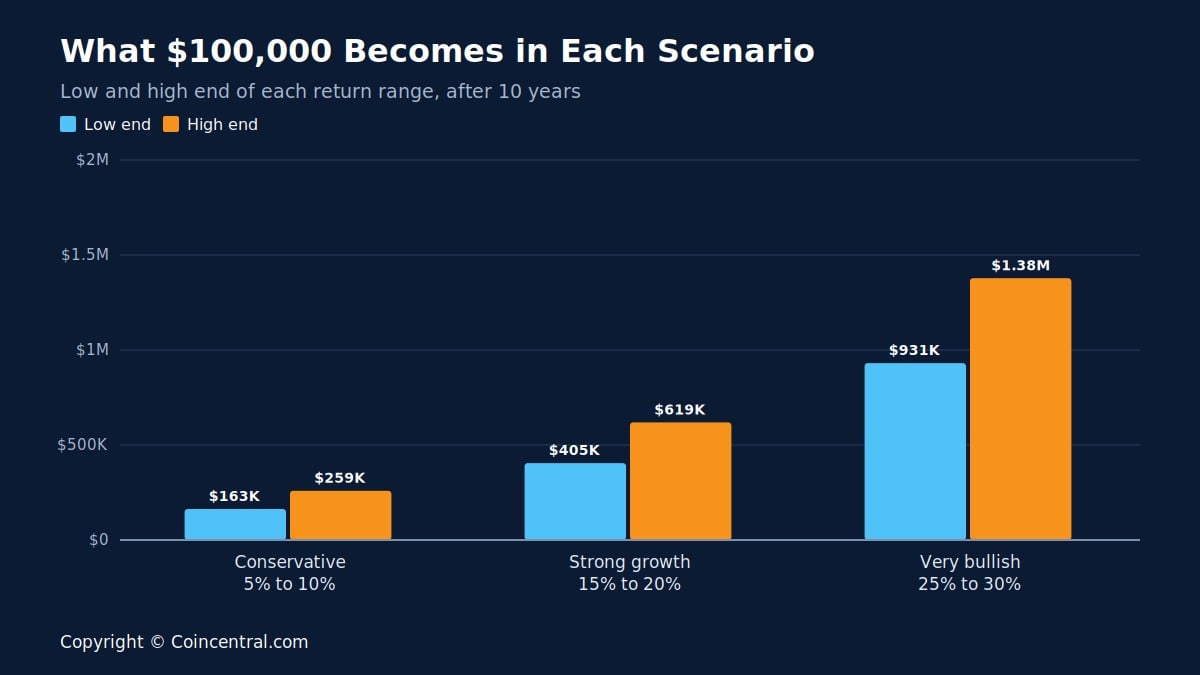
Rather than guess one exact price for 2036, it helps to look at ranges. The table groups the return rates into three scenarios.
| Scenario | Annual return | BTC price in 2036 | $10,000 becomes | $100,000 becomes |
|---|---|---|---|---|
| Conservative | 5% to 10% | $133,000 to $212,000 | $16,000 to $26,000 | $163,000 to $259,000 |
| Strong growth | 15% to 20% | $330,000 to $506,000 | $40,000 to $62,000 | $405,000 to $619,000 |
| Very bullish | 25% to 30% | $761,000 to $1.13 million | $93,000 to $138,000 | $931,000 to $1.38 million |
The conservative case would still be positive growth. It would not create life-changing wealth for most people who start with modest sums.
The strong-growth case would beat most traditional assets. Even so, it would not turn $10,000 into $1 million.
In the very bullish case, a $50,000 investment would become $466,000 to $689,000. Holding 25% to 30% growth from a $1.6 trillion start would take a large amount of new global demand.
What About Regular Monthly Investing?
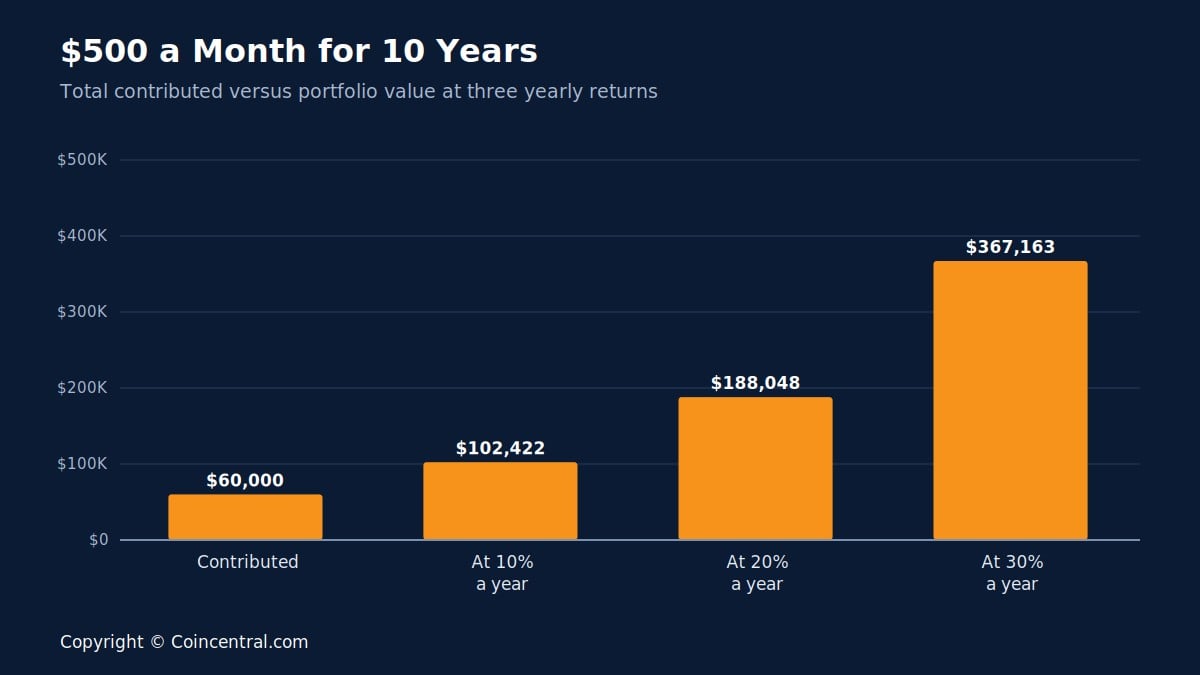
The math improves when an investor keeps adding money. Take someone who invests $500 a month for ten years. Total contributions would be $60,000.
This simple model adds one-twelfth of the yearly return each month. At 10% a year, the portfolio would reach about $102,000. At 20%, it would reach about $188,000, and at 30%, about $367,000.
Real results depend on when each purchase happens and on Bitcoin’s actual price path. The idea still holds. For most people, the realistic route to wealth is not one small bet that grows 100-fold.
It is starting capital, regular saving, time and compounding together. Bitcoin may speed that up if returns are strong. It cannot replace the need for money to invest.
Why Inflation Matters
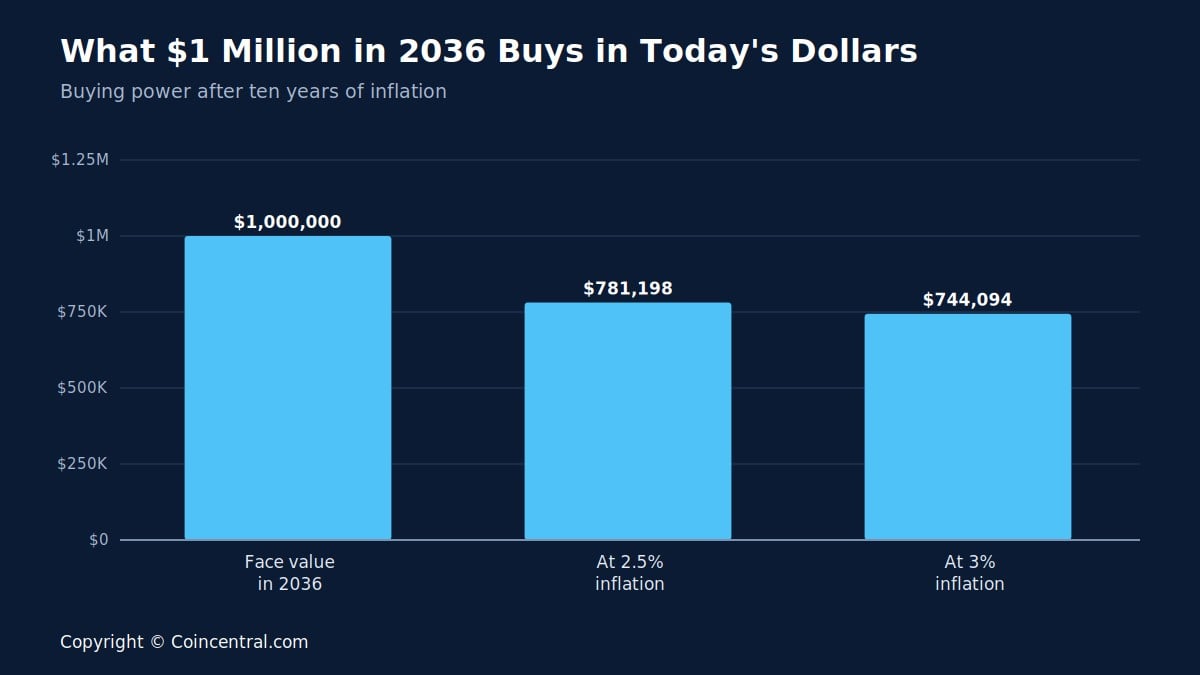
A million dollars in 2036 will not buy what $1 million buys today. Suppose inflation averages 2.5% a year. Over ten years, prices would rise by about 28%.
In that case, $1 million in 2036 would have the buying power of about $780,000 today. At 3% inflation, today’s equivalent would be closer to $744,000.
A future millionaire is still wealthy. Even so, targets should be adjusted for inflation. This matters most for people asking if Bitcoin could fund retirement.
The goal should be based on future spending power, not on a round number that looks nice.
Limited Supply, Demand and Rules
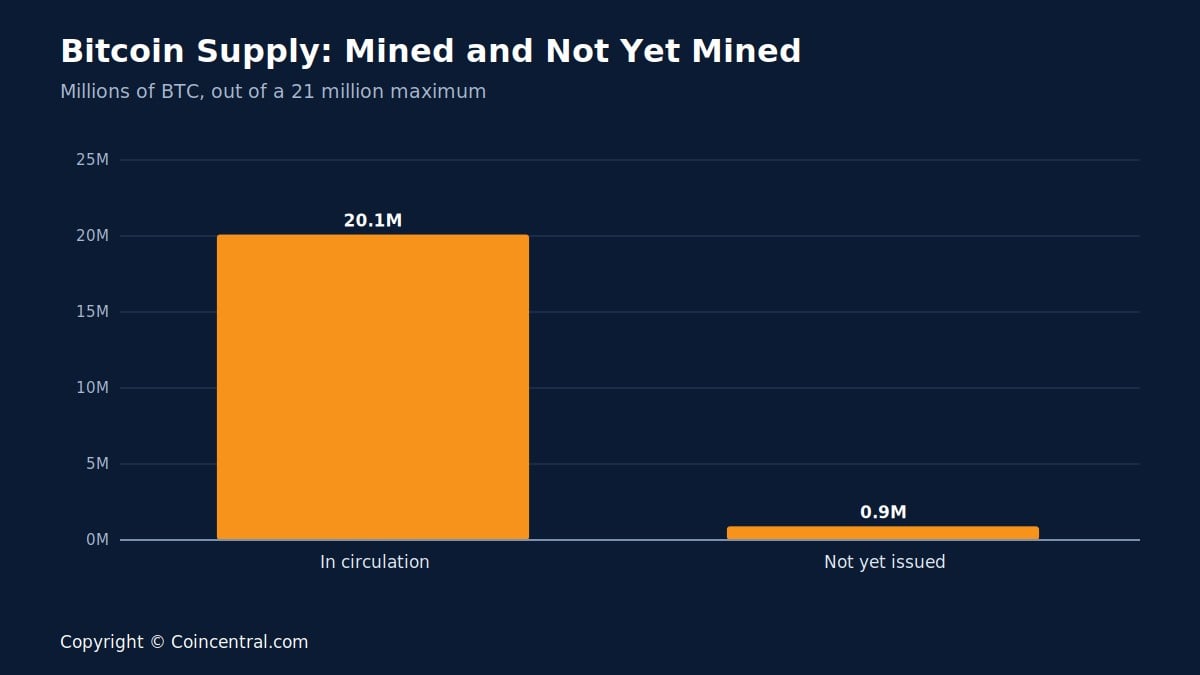
The bull case starts with scarcity. Bitcoin’s maximum supply is 21 million coins, and about 20.1 million already exist. New issuance keeps falling through the halving process.
If demand rises while new supply shrinks, the price should rise until buyers and sellers balance. Possible sources of demand include institutions, ETFs, corporations, wealth platforms, governments and individual investors.
There is a counterargument. Scarcity only matters if demand continues. An asset can be rare and still have little value if few people want it.
The 21 million limit does not guarantee a price of $500,000, $1 million or $10 million. Future returns depend on Bitcoin keeping and growing its roles as a store of value, a portfolio diversifier and collateral. Weak adoption, competition, rules or technical problems could cut demand.
Bitcoin’s institutional position is stronger than in 2016. It now trades through regulated products that did not exist then.
BlackRock said in August 2026 that Bitcoin may justify a modest strategic share of a diversified portfolio. Its ten-year analysis suggested that a 60/40 portfolio would have had better risk-adjusted returns with a small Bitcoin share. Fidelity reached similar views but stressed position sizing because of volatility.
Forecasts Are Not Guarantees
Long-term Bitcoin forecasts often use round numbers such as $250,000, $500,000, $1 million or $5 million. A spreadsheet cannot predict future demand. It can only answer one question: if Bitcoin returns a set percentage a year, what happens?
That is still useful. Scenario analysis separates outcomes that need reasonable growth from outcomes that need extreme assumptions. It also shows why very small investments rarely create generational wealth unless Bitcoin has another historic decade.
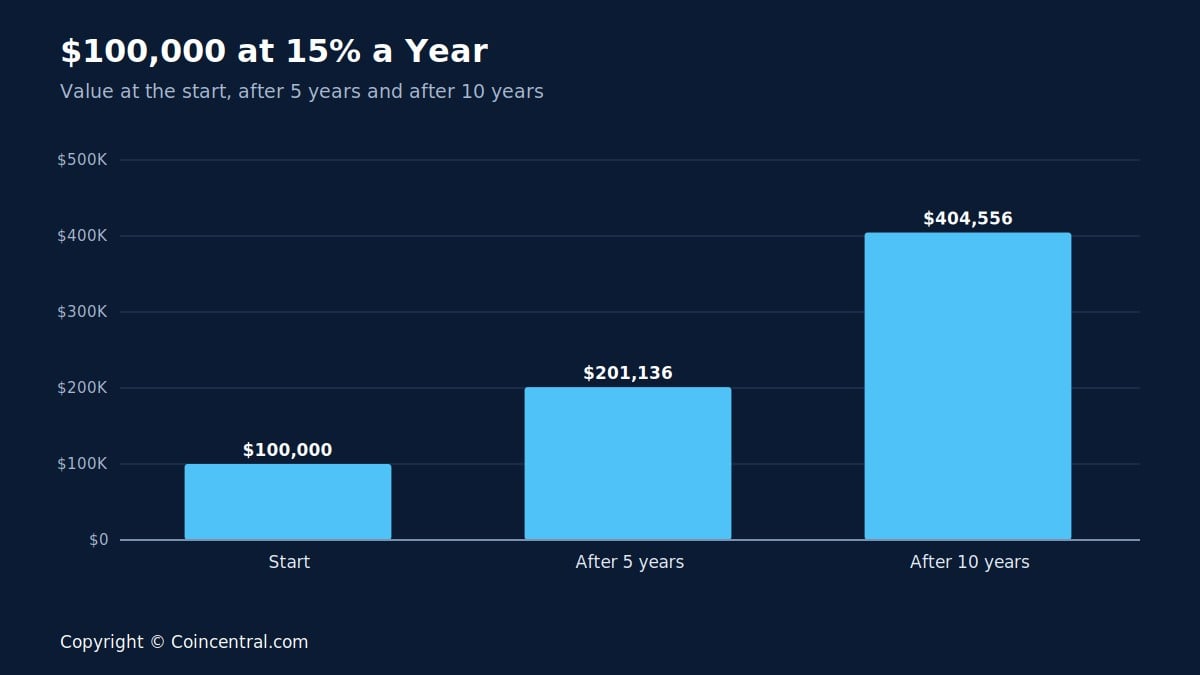
Bitcoin also does not need to make you a millionaire to be a good investment. Suppose it compounds at 15% a year for ten years. That would turn $100,000 into about $405,000, a fourfold gain.
By most standards, that would be a strong result. But Bitcoin’s history includes gains of 10 times, 100 times and more, so some investors expect too much. A rise from $82,000 to $330,000 could feel weak next to the past, yet in money terms it would still be a large gain.
The Bottom Line
Can Bitcoin make you rich over the next ten years? It can, but the amount you invest today matters almost as much as Bitcoin’s future price.
A $10,000 investment needs about 58.5% a year to reach $1 million within a decade. That would take Bitcoin above $8 million per coin, which is a very aggressive assumption.
A $100,000 investment needs about 25.9% a year. That matches a Bitcoin price near $800,000 to $820,000. A more moderate 15% to 20% a year would put Bitcoin near $330,000 to $506,000 by 2036 and turn $100,000 into $405,000 to $619,000.
Bitcoin rose from about $657 in October 2016 to about $81,700 today, a yearly rate near 62%. Over the same time, its market value grew from about $10 billion to $1.6 trillion. The larger Bitcoin becomes, the harder another 100-fold gain gets.
The more likely route to wealth combines meaningful starting money, regular investing, long holding periods, realistic return goals and the ability to sit through large drops. The math shows that how much wealth Bitcoin can build depends on how much you start with and how high your assumptions are.
Sources